Why Your Phone Battery Degrades And What Happens Chemically
by Scott
Lithium ion batteries have become so common that it is easy to forget how chemically complex they are. The slim rectangular cell inside your phone is not just a container of stored electricity. It is a carefully engineered electrochemical system built around reversible lithium ion movement between two host materials. Over time, that reversibility degrades. The chemistry changes, the structure of materials shifts, and the battery slowly loses capacity and performance. What most people experience as shorter screen time or unexpected shutdowns is the visible result of microscopic chemical evolution inside the cell.
At its core, a lithium ion battery consists of a graphite anode, a lithium metal oxide cathode, a porous separator, and a liquid electrolyte containing lithium salts. During discharge, lithium atoms in the anode give up electrons and become lithium ions. These ions travel through the electrolyte and separator toward the cathode. At the same time, electrons flow through the external circuit to power the phone. When charging, the process reverses. Lithium ions are driven back into the graphite structure of the anode, and electrons return through the charger circuit. In an ideal system, this shuttling could continue indefinitely. In reality, every charge and discharge cycle introduces small irreversible changes.
One of the most important chemical phenomena in lithium ion batteries is the formation of the solid electrolyte interphase, often abbreviated as SEI. When a battery is first charged, the electrolyte reacts with the graphite anode surface and forms a thin protective layer. This layer is necessary. Without it, the electrolyte would continue decomposing uncontrollably. The SEI acts as a passivation film that allows lithium ions to pass but blocks electrons. However, it is not perfectly stable. With each cycle, mechanical stress and side reactions can cause the SEI to crack and reform. Each time it reforms, a small amount of lithium becomes permanently trapped in new reaction products. This reduces the pool of active lithium available to shuttle between electrodes, which directly reduces capacity.
Thermal stress accelerates this process. Chemical reactions generally proceed faster at higher temperatures. When a phone runs hot due to gaming, video recording, or fast charging, the rate of electrolyte decomposition increases. Elevated temperature also promotes unwanted reactions at both the anode and cathode. Over time, high temperature exposure thickens the SEI layer and increases internal resistance. Increased resistance means more energy is lost as heat during operation, which further accelerates degradation in a feedback loop.
Charge cycles are often misunderstood. A cycle does not necessarily mean charging from zero to one hundred percent in one go. Instead, it refers to the cumulative equivalent of a full discharge and recharge. Two half discharges and recharges equal one full cycle. Each cycle slightly stresses the electrode materials. In the graphite anode, lithium intercalates between layers of carbon atoms. This causes slight expansion and contraction of the structure. While graphite is relatively stable, repeated expansion can create mechanical fatigue over hundreds of cycles. On the cathode side, materials such as lithium cobalt oxide or nickel manganese cobalt oxides undergo structural changes as lithium ions move in and out. These materials can develop microcracks, especially when pushed to high voltage limits. Microcracks expose fresh surface area to the electrolyte, triggering additional side reactions and capacity loss.
Voltage range has a significant impact on battery longevity. Charging to a very high state of charge pushes the cathode material into a highly oxidized state. This increases mechanical stress and makes the cathode more reactive with the electrolyte. Similarly, discharging to very low voltage can destabilize the anode structure. For this reason, battery management systems in smartphones often avoid using the absolute chemical limits of the cell. Even when your phone displays zero percent, the battery is not truly empty. Likewise, one hundred percent is usually slightly below the maximum electrochemical voltage the cell could tolerate.
Fast charging introduces additional stress. Rapid charging requires higher currents, which increase internal heating and concentration gradients within the electrodes. Lithium ions must move quickly into the graphite structure. If they cannot intercalate smoothly, lithium plating can occur. Lithium plating means metallic lithium deposits on the surface of the anode rather than entering the graphite layers. This plated lithium is often irreversible and can form dendritic structures. In extreme cases, dendrites can grow across the separator and cause short circuits. In normal consumer use, plating is usually limited but still contributes to long term degradation.
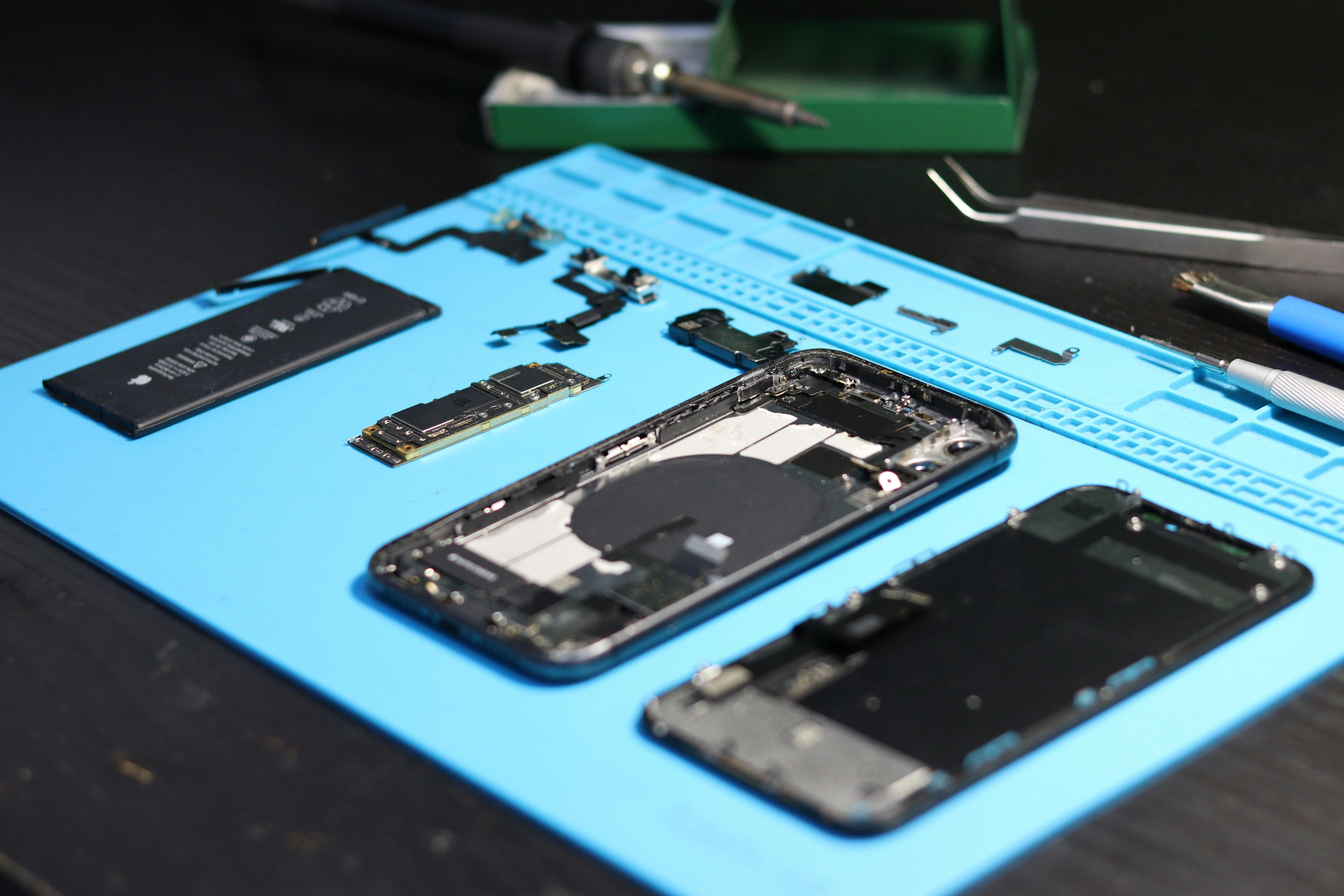
Another aging mechanism is electrolyte breakdown. The liquid electrolyte contains lithium salts dissolved in organic solvents. These solvents can oxidize at high voltage or reduce at low voltage. Over time, decomposition products accumulate, increasing internal resistance and reducing ionic conductivity. Gas formation can also occur, leading to slight swelling of the battery pouch. While modern cells are engineered to minimize this, chemical aging inevitably alters the internal composition.
Calendar aging is distinct from cycle aging. Even if a battery is rarely used, it will degrade over time simply by sitting at a certain state of charge. High states of charge combined with elevated temperatures accelerate chemical side reactions. This is why storing a phone fully charged in a hot environment for extended periods can significantly shorten its lifespan. The combination of voltage stress and thermal energy drives slow but continuous electrolyte and electrode reactions.
Battery management systems attempt to mitigate these processes through a combination of hardware and software controls. At the hardware level, temperature sensors monitor cell conditions. If the battery becomes too hot or too cold, charging rates are reduced or halted. Voltage limits are carefully controlled to avoid extreme conditions. Current flow is regulated to prevent excessive stress. At the software level, modern smartphones may implement adaptive charging strategies. For example, the system can learn a user charging pattern and delay charging to full capacity until shortly before the device is expected to be unplugged. This reduces the amount of time the battery spends at high voltage.
State of charge estimation is itself a complex task. The battery management system measures voltage, current, and temperature to estimate how much capacity remains. As the battery ages and internal resistance increases, these estimations must adapt. A degraded battery may show rapid drops in percentage under load because voltage sag becomes more pronounced. To protect the device, operating systems may reduce peak processor performance when battery health declines. This prevents sudden shutdowns caused by voltage dips during high current draw.
Materials science continues to evolve in an effort to slow degradation. Researchers are developing new cathode chemistries with greater structural stability and lower reactivity. Silicon enriched anodes offer higher capacity but introduce additional mechanical expansion challenges. Advanced electrolytes with additives can form more stable SEI layers. Solid state battery concepts aim to replace flammable liquid electrolytes with solid conductors, potentially reducing some degradation pathways. However, even with improved materials, the fundamental challenge remains that lithium ion movement involves repeated structural change at the atomic scale.
In practical terms, battery degradation is a gradual loss of lithium inventory and an increase in internal resistance. Capacity fade means fewer ampere hours are available. Resistance growth means more voltage drop under load and more heat generation. Together, these effects reduce runtime and can make a phone feel less reliable. What appears to be simple aging is actually a complex interplay of electrochemistry, thermodynamics, mechanical stress, and material science.
Your phone battery does not fail suddenly in most cases. It evolves chemically with every cycle and every hour spent at elevated temperature or high voltage. The battery management system works continuously in the background to keep these changes within acceptable limits, but it cannot stop them entirely. The tradeoff between energy density, power delivery, size, and longevity defines modern lithium ion design. As long as portable electronics demand high energy in small packages, controlled chemical aging will remain an unavoidable reality of rechargeable batteries.