Why Hard Drives Still Spin in a Solid State World
by Scott
There is something almost anachronistic about the spinning hard drive in 2026. It is a mechanical device in an era defined by the elimination of moving parts. It contains platters that rotate thousands of times per minute, an actuator arm that swings back and forth across those platters, and a read and write head that floats on a cushion of air a few nanometers above the surface, closer to the platter than a human red blood cell is wide. It vibrates, generates heat, consumes power, and is vulnerable to physical shock in ways that a solid-state drive, with no moving parts whatsoever, simply is not. The solid-state drive is faster in almost every measure that matters to the experience of using a computer. It boots the operating system in seconds rather than minutes. It opens applications almost instantaneously. It handles the random read and write operations that dominate everyday computing workloads many times faster than any spinning drive can manage.
And yet the spinning hard drive has not died. It has not even come close to dying. Hundreds of millions of hard drives continue to ship every year. Exabytes of data continue to be written to spinning platters and read back from them. The data centers that store the world’s cloud files, backup archives, streaming video libraries, and surveillance footage run enormous quantities of spinning drives alongside their faster solid-state counterparts. The hard drive industry has continued to invest in the technology, pushing capacities to levels that seemed implausible a decade ago, and the roadmap for future capacity increases suggests that spinning drives will remain relevant for the foreseeable future. To understand why, you need to understand the one dimension in which the spinning hard drive has no serious rival, and why that dimension turns out to matter enormously at the scale at which modern digital storage actually operates.
That dimension is cost per gigabyte. Solid-state storage has become dramatically cheaper over the past decade, following a trajectory that once seemed like it would inevitably converge with and then undercut hard drive pricing. In the early 2010s, the cost premium for solid-state storage over spinning storage was enormous, ten times or more per unit of capacity, and most analysts assumed that the steady decline in flash memory costs would eventually close that gap completely. What actually happened is more complicated. Solid-state costs have fallen substantially, and for consumer-grade storage the gap has narrowed to the point where many buyers, particularly of laptops and desktop computers used for general computing, choose solid-state drives even at some cost premium because the performance benefit is clearly worth it. But at the high-capacity end of the market, the cost gap between spinning and solid-state storage has proven remarkably persistent, and at very large scale it translates into economic differences that are simply too large to ignore.
The economics of storing data at scale are driven by a cost-per-terabyte calculation that favors spinning drives more strongly as the capacity required increases. A hyperscale data center storing multiple exabytes of data, the kind of facility operated by companies like Amazon, Google, and Microsoft to store customer files and run cloud services, faces storage economics that are qualitatively different from the economics faced by an individual consumer buying a laptop. At consumer scale, paying twice as much for a solid-state drive in order to get dramatically better performance is often a sensible tradeoff. At exabyte scale, paying twice as much for every terabyte of storage capacity means paying billions of additional dollars that provide no meaningful benefit for the specific workloads that cold storage and archival applications involve. For data that is written once and read occasionally, performance is not the primary consideration. Capacity per dollar is.
The hard drive industry has responded to the competitive pressure from solid-state storage by focusing its engineering resources on increasing capacity per drive rather than competing on performance. The result has been a sustained progression of capacity milestones that has kept hard drives economically relevant. The techniques used to achieve these increases are remarkable in their ingenuity and tell an interesting story about how far a mature technology can be pushed by sustained engineering pressure.
The fundamental challenge of increasing hard drive capacity is packing more bits onto the same physical area of magnetic platter. The amount of data that can be stored per unit of platter area is called areal density, and increasing it requires making the individual magnetic domains used to store bits smaller, which in turn requires reading and writing smaller magnetic features without the signal degrading to the point where it cannot be reliably distinguished from noise. For most of the history of hard drives, the progression of areal density followed a trajectory that observers compared to Moore’s Law in its regularity, roughly doubling every year or two through improvements in magnetic materials, head design, and signal processing electronics.
That progression eventually hit a fundamental physical barrier. As magnetic domains are made smaller, they become thermally unstable, vulnerable to the random thermal energy in their environment flipping their magnetic orientation and erasing the stored data. This superparamagnetic limit threatened to halt areal density increases in the early 2000s and prompted the development of perpendicular magnetic recording, a technique that oriented the magnetic domains vertically rather than horizontally on the platter surface, allowing smaller and more stable domains. Perpendicular recording extended the areal density progression for another decade and a half.
The next significant advance was shingled magnetic recording, a technique that writes tracks partially overlapping in the manner of roof shingles rather than leaving gaps between them. This allows more tracks to be packed onto a platter surface, increasing capacity, but it introduces complications for overwriting data because a write operation on one track partially overwrites adjacent tracks and may require those tracks to be rewritten. Shingled magnetic recording is well suited to workloads that involve mostly sequential writing and relatively infrequent overwriting, which describes many archival and cold storage applications. It is less well suited to workloads that involve frequent random writes, which limits its applicability but not its relevance for the specific use cases where hard drives remain dominant.
The most ambitious recent advance in hard drive technology is heat-assisted magnetic recording, a technique developed primarily by Seagate that uses a tiny laser mounted on the read-write head to briefly heat the magnetic material on the platter surface to a temperature at which smaller magnetic domains can be written, then allows it to cool back to ambient temperature where the domain becomes thermally stable. This approach addresses the fundamental tradeoff between writability and thermal stability that had constrained areal density increases, by temporarily modifying the material properties of the platter surface to allow writing and then relying on the stable room-temperature properties to preserve the data. Seagate shipped the first hard drives using heat-assisted magnetic recording for commercial use around 2023, and the technology is expected to push capacities to levels that would have seemed extraordinary just a few years ago.
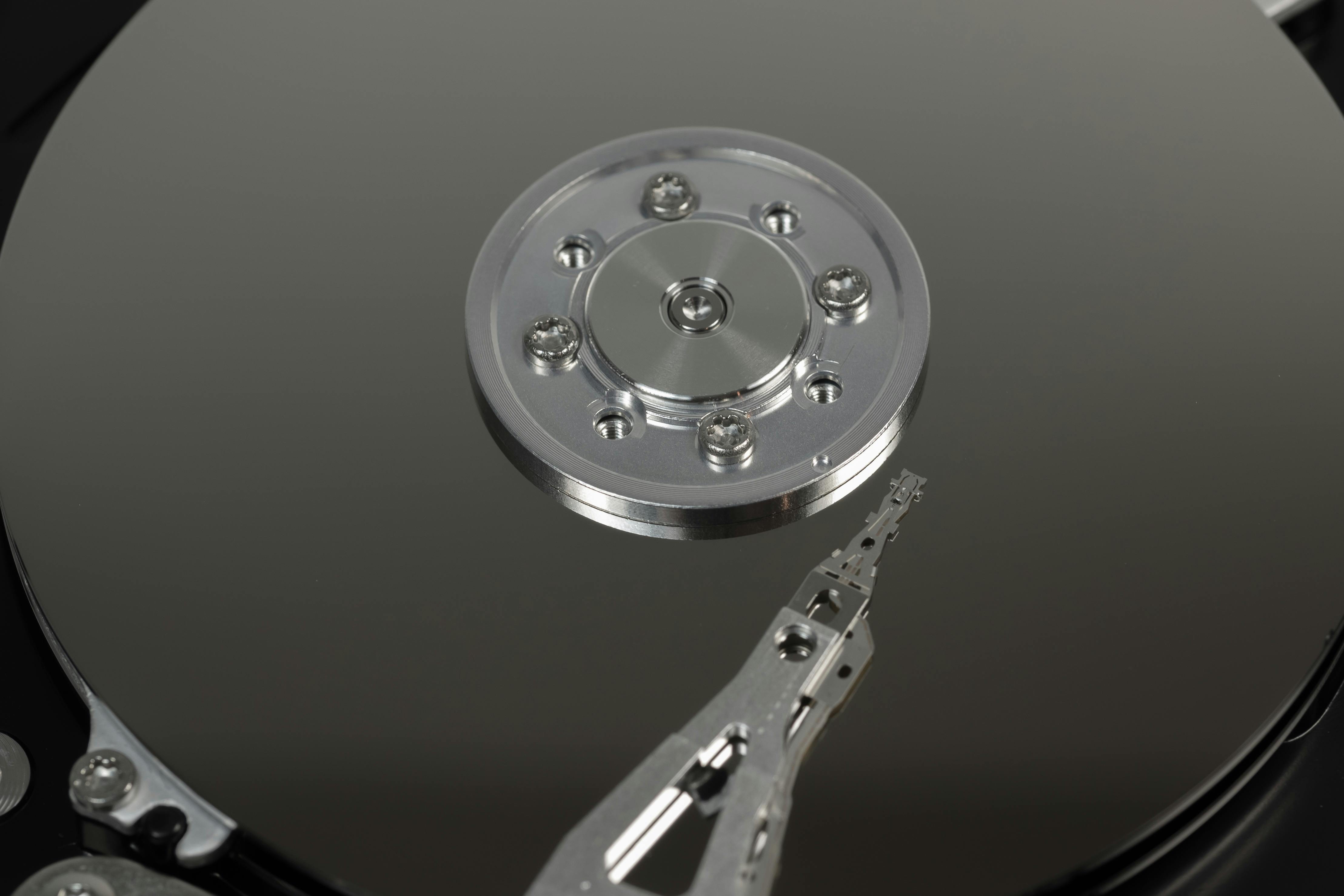
Western Digital has pursued a parallel approach called energy-assisted magnetic recording that uses microwave-assisted switching rather than heat to enable writing to very stable magnetic materials. Both approaches represent the continuation of sustained engineering effort to keep hard drive capacity increasing despite the fundamental physical challenges involved, and both represent the kind of investment that only makes economic sense if hard drives have a substantial future market to serve.
The specific workloads that favor hard drives are concentrated in several areas that collectively account for enormous amounts of data storage. Archival and cold storage, meaning data that is written and then accessed rarely or never, is perhaps the clearest case. An organization that needs to retain years of records, audit logs, compliance documentation, or historical data for regulatory reasons needs storage that is cheap and reliable, and essentially never needs that storage to be fast. For this use case, the performance advantages of solid-state storage are irrelevant, and the cost advantages of hard drives are compelling.
Video storage represents another major category. The rise of streaming video services, surveillance systems, and user-generated video content has produced a demand for storage that is almost incomprehensible in its scale. A single high-definition streaming service maintaining multiple quality versions of a library that includes hundreds of thousands of titles, along with the originals and production files from which those versions were derived, requires storage measured in exabytes. Video data is typically written once and streamed many times, a pattern of sequential reading that is well suited to hard drives, and the economics of storing it on solid-state drives at that scale would be prohibitive. The servers that deliver streaming video to consumers do rely heavily on solid-state storage for their caching layers, where frequently accessed content is held in fast storage to minimize latency, but the deep storage tier where the full library resides is almost universally spinning disk.
Backup storage is similarly favorable to hard drives. Backup data by definition represents a copy of data that already exists elsewhere, data that is written once and ideally never read again unless a recovery is needed. Performance of the backup storage tier is almost never the critical factor in backup operations, while cost and capacity are both highly significant. Organizations that back up large volumes of data to on-premises storage or that operate backup-as-a-service businesses have strong economic incentives to use spinning drives for the bulk of their backup storage capacity.
The persistence of spinning drives is also supported by the inertia and infrastructure that surround them in data center environments. Organizations that have made substantial investments in hard drive-based storage infrastructure, that have developed operational practices and management tools around that infrastructure, and that have data migration processes designed for its characteristics are not going to replace it overnight even if the economic case for doing so were strong, which it generally is not. The transition to solid-state storage has proceeded faster in the tier of frequently accessed, performance-sensitive data, and more slowly in the tier of rarely accessed, capacity-sensitive data, for reasons that track closely with the actual economics of the two technologies.
The hard drive industry has also benefited from the fact that the primary use case it dominates, high-capacity cold storage, is a use case that is growing rather than shrinking. The total volume of data being generated and retained globally continues to increase at a rate that stretches the capacity of all available storage technologies. Surveillance cameras generate continuous video that many organizations are required or choose to retain for months or years. Internet of Things devices generate sensor data that accumulates over time. Social media platforms accumulate user-generated content that is expected to remain accessible indefinitely. Scientific instruments, from genomic sequencers to radio telescopes to particle accelerators, generate data at rates that challenge the storage infrastructure of even well-funded research institutions. The demand for cheap, high-capacity storage is not contracting. It is expanding, and that expansion is providing the market that justifies continued investment in hard drive technology.
It is worth noting that the relationship between spinning drives and solid-state drives in modern storage systems is not purely competitive. In many real-world implementations the two technologies are used together in tiered storage architectures that assign data to the technology best suited to how it is accessed. Frequently accessed data lives on fast solid-state storage where it can be retrieved quickly. Less frequently accessed data migrates over time to spinning drives where it can be retained cheaply. Very cold data that may never be accessed again might migrate further, to tape storage, which offers even lower cost per terabyte than spinning disk at the expense of even slower access times. This tiered approach means that the question of which technology wins is somewhat artificial. Both win, in different tiers, and the architecture that uses both is often more cost-effective than one that uses either alone.
There is something philosophically interesting about the persistence of the hard drive that goes beyond the economics. The technology is, by the standards of modern electronics, extraordinarily old. The first hard drive, IBM’s RAMAC 350, was introduced in 1956 and stored five megabytes on fifty magnetic disks each two feet in diameter. The fundamental principle, encoding data as magnetic orientations in a thin film on a spinning platter, is essentially unchanged across nearly seven decades of development. The individual components have been refined to a degree that their inventors could not have imagined, with modern platters coated in magnetic materials a few nanometers thick and heads that float at heights measurable in atoms. But the underlying mechanism is recognizable as the same mechanism. The hard drive is one of the longest-lived technologies in the history of computing, and its longevity reflects a combination of fundamental physical advantages in cost and capacity that have proven resistant to displacement and sustained engineering effort that has kept those advantages intact even as competitors developed around it.
The death of the hard drive has been predicted regularly since solid-state storage emerged as a viable technology. Each prediction has been premature, for the same reason: the predictions focused on performance and failed to adequately weight the cost-per-terabyte economics that dominate the use cases where hard drives are most entrenched. At current rates of technology development, solid-state storage costs will continue to fall and hard drive capacities will continue to rise, and the two trajectories will eventually cross at the high capacity end of the market as they have already crossed in the consumer computing segment. When that crossing happens, the spinning drive may finally face the displacement that has been predicted for it for two decades. Until it does, and the timeline remains genuinely uncertain, the platters will keep spinning.