The Engineering Behind High Speed Fiber Internet
by Scott
When most people think about high speed fiber internet, they imagine light racing through a thin strand of glass at unimaginable speeds. That image is not wrong, but it hides an extraordinary amount of engineering. Fiber networks are not simply lasers pointed down cables. They are carefully balanced optical systems designed to move enormous amounts of data across cities, countries, and oceans with minimal loss and minimal error.
At its core, fiber optic communication relies on total internal reflection. A fiber strand is made of an ultra pure glass core surrounded by cladding with a slightly lower refractive index. When light enters the core at the correct angle, it reflects internally along the length of the fiber rather than escaping. This allows pulses of light to travel tens or even hundreds of kilometers with relatively low attenuation.
Modern high speed fiber systems do not transmit a single beam of light carrying a single stream of data. Instead they use wavelength division multiplexing. In simple terms, multiple colors of light, each representing a different wavelength, are injected into the same fiber simultaneously. Each wavelength carries an independent data channel. At the receiving end, optical filters and demultiplexers separate those wavelengths back into distinct data streams.
Dense wavelength division multiplexing dramatically increases capacity. A single fiber strand can carry dozens or even hundreds of wavelengths, each operating at tens or hundreds of gigabits per second. In large backbone networks, aggregate capacities can reach terabits per second on a single pair of fibers. This approach is far more efficient than laying new physical cables for each increase in demand.
The engineering challenge lies in keeping those wavelengths stable and separated. Lasers must emit at precisely controlled frequencies with extremely narrow linewidths. Temperature changes can cause wavelength drift, so optical transmitters incorporate thermal control systems to maintain spectral stability. Even slight overlap between channels can introduce crosstalk and degrade signal integrity.
As light travels through fiber, it inevitably loses strength. This phenomenon is known as attenuation. Attenuation occurs because of absorption and scattering within the glass. Even in extremely pure fiber, microscopic imperfections and molecular interactions reduce signal power over distance. Modern single mode fiber typically has attenuation around 0.2 decibels per kilometer at common transmission wavelengths near 1550 nanometers. While that is impressively low, over long distances the cumulative loss becomes significant.
To overcome attenuation, optical amplification is used. Instead of converting the optical signal back to electrical form and regenerating it at each interval, modern long haul systems often use erbium doped fiber amplifiers. In these devices, a segment of fiber is doped with erbium ions. A separate pump laser excites the erbium atoms into a higher energy state. When the incoming signal passes through, it stimulates emission from the excited erbium ions, amplifying the light directly in the optical domain.
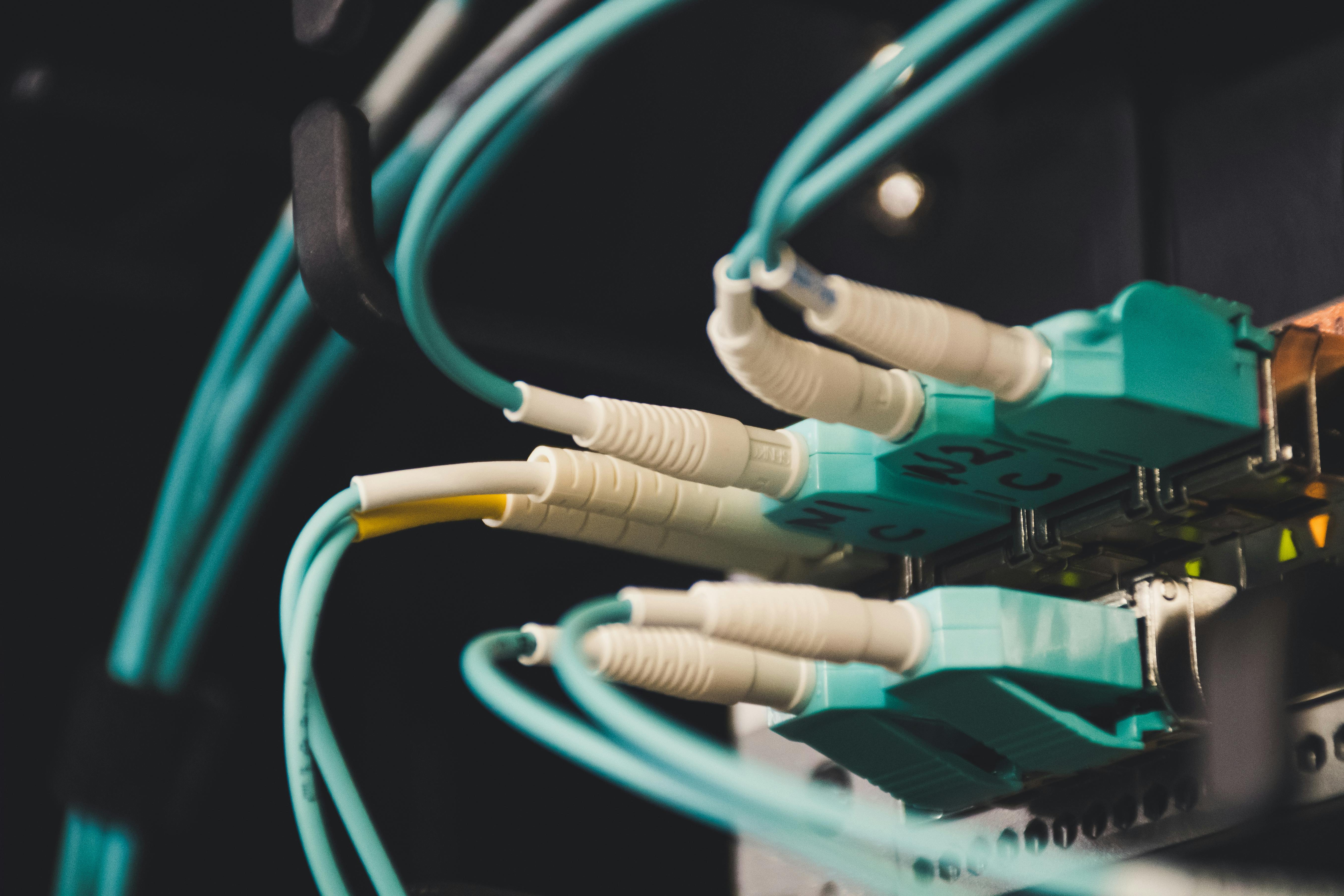
Optical amplification is one of the key breakthroughs that enabled global fiber networks. Because the signal remains optical, it can amplify multiple wavelengths at once without demultiplexing them. This dramatically simplifies long distance transmission and supports dense wavelength division multiplexing systems over hundreds or thousands of kilometers.
However amplification introduces noise. Spontaneous emission within the amplifier adds background noise to the signal, reducing the optical signal to noise ratio. Engineers must carefully manage amplifier spacing and power levels to balance attenuation and noise accumulation. Too much amplification can also introduce nonlinear effects in the fiber, such as self phase modulation and four wave mixing, which distort signals when optical power densities become too high.
Another important factor in high speed fiber systems is dispersion. Light pulses are not infinitely narrow. As they travel through fiber, different frequency components of the pulse move at slightly different velocities. This causes pulses to spread out in time, potentially overlapping with adjacent pulses and creating intersymbol interference. Dispersion compensation techniques, including specialized fiber segments and digital signal processing in coherent receivers, are used to correct for this spreading.
In modern systems, coherent optical transmission has become standard for high capacity links. Instead of simply detecting light intensity, coherent receivers measure both amplitude and phase of the optical signal. Advanced modulation schemes such as quadrature amplitude modulation allow multiple bits to be encoded per symbol. Powerful digital signal processors then reconstruct the transmitted data, compensating for dispersion and other impairments in real time.
In access networks that deliver fiber to homes, the architecture differs somewhat from long haul systems. Passive optical networks use optical splitters to distribute a single fiber from a central office to multiple subscribers. Downstream data is broadcast to all users on a shared wavelength, while upstream data is carefully time multiplexed so that subscribers transmit in allocated time slots to avoid collisions. Even here, wavelength management and power budgeting are critical to ensure reliable service across varying distances.
Beyond the physics, there is also the mechanical and environmental engineering of fiber networks. Fibers must be protected within cables that can survive temperature extremes, moisture, physical stress, and in some cases deep ocean pressures. Submarine cables include repeaters powered through the cable itself and must be engineered for decades of continuous operation under immense hydrostatic pressure.
The remarkable aspect of high speed fiber internet is not just that light carries data, but that entire global economies depend on precisely tuned optical systems operating within tight physical constraints. Wavelength multiplexing allows extraordinary capacity. Optical amplification keeps signals alive across continents. Careful management of attenuation and dispersion preserves data integrity at rates that would have been unimaginable a few decades ago.
What feels like instant access to cloud services or high definition streaming is in reality the result of finely controlled lasers, doped fiber amplifiers, nonlinear optical physics, and digital signal processing all working together. Fiber internet is often marketed in simple terms, but beneath that simplicity lies one of the most elegant and demanding engineering achievements of the modern world.